

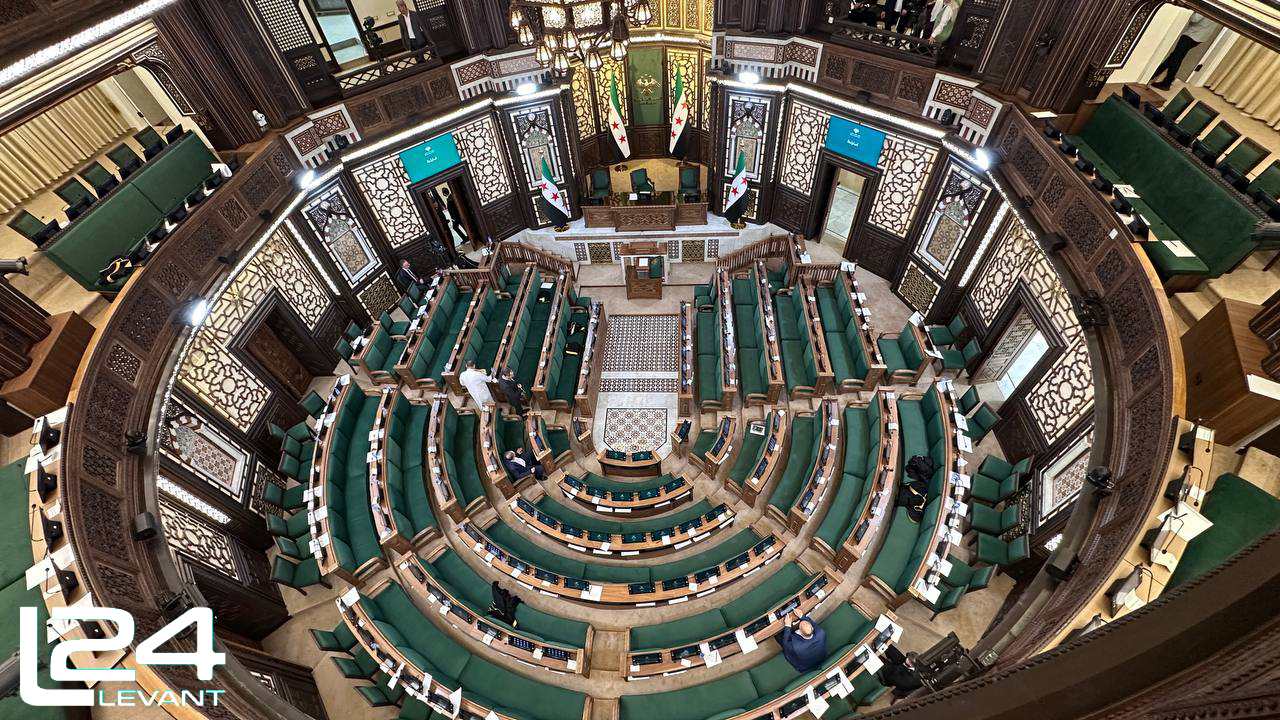
Syrian People's Assembly during a break in proceedings Sunday July 12, 2026. Damascus (Levant24)
The Syrian People’s Assembly convened its first session Sunday
since the fall of the Assad regime, marking the return of a
legislative body that now faces the challenge of helping shape the
country’s political transition.
The 210-seat assembly met under the framework of the Constitutional Declaration, with 207 members participating after three seats allocated to Suwayda remained vacant because elections could not be completed there. Members took the constitutional oath before President Ahmad al-Sharaa before electing constitutional law scholar Abdulhamid al-Awak as speaker. Mustafa Musa and Madonna Bishara were elected deputy speakers, while Muayyad Habib was chosen as secretary.
In his address, Sharaa described the assembly as “a platform for truth and justice” and urged members to strengthen dialogue, the rule of law and respect for state institutions. He called on lawmakers to work collectively and place public service at the center of every decision.
Building Parliament From the Ground Up
Beyond electing its leadership, the assembly’s most immediate responsibility is establishing how it will govern itself. Under the transitional framework, lawmakers have 30 days, between August 11 and 12, to draft and approve the body’s internal rules of procedure, making the coming weeks one of the most formative periods in the institution’s development.
Speaker Awak announced that a specialized committee has already begun preparing the draft regulations, while inviting members from across the assembly to participate in the process. The proposed rules will be presented for debate and approval during the assembly’s next session on July 26.
The internal regulations will determine how legislation advances through parliament, how committees operate, how oversight responsibilities are exercised and how members conduct legislative business. The process also represents one of the assembly’s first opportunities to independently shape its own institutional identity after decades in which Syria’s parliament was widely viewed as lacking meaningful autonomy.
Legislative Challenges Ahead
The People’s Assembly enters the transitional period with broad legislative and oversight authority. In addition to passing laws, approving the national budget and reviewing international agreements, lawmakers are expected to overhaul legislation inherited from the Assad regime while preparing the legal framework for a permanent constitution and future general elections.
Among the priorities expected to come before the assembly are
legislation governing transitional justice, political parties,
elections, judicial independence, local administration and public
institutions. International officials described the opening session
as an important milestone in Syria’s political transition.
Whether the new parliament succeeds, however, will likely
depend not only on the laws it passes but also on how effectively it
establishes transparent procedures, exercises independent oversight
and builds public confidence during this critical phase of rebuilding
the Syrian state.