

The conversation surrounding Syria’s economy is shifting beyond
coping with the aftermath of war toward advancing recovery,
rebuilding economic ties, and creating new investment opportunities.
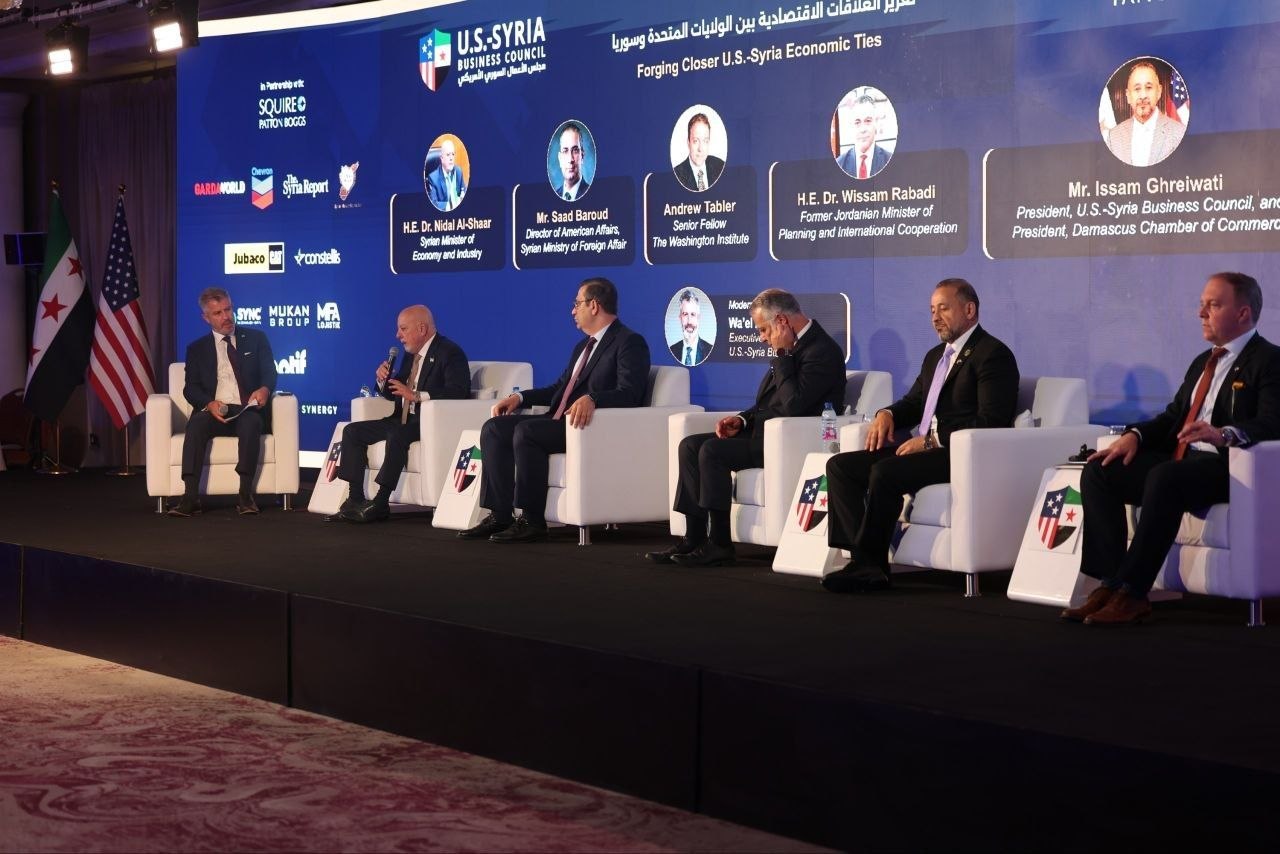
Against this backdrop, the first Syrian-American Business Forum, held
in Damascus, signaled a coordinated effort to establish a new
economic path based on partnership, regulatory modernization, and the
attraction of expertise and capital.
Organized by the Ministry of Economy and Industry in collaboration with the US-Syrian Business Council, the forum brought together government officials and representatives from key economic and commercial sectors in Syria and the US. Discussions focused on Syria’s economic recovery, investment opportunities, and the country’s broader reform agenda.
From Recovery to Economic Partnership
Minister of Economy and Industry Nidal al-Shaar described the forum as the beginning of a new chapter in Syrian-US economic relations built on cooperation and a shared vision. He pointed to recent progress in removing barriers to trade and investment but stressed that the greater challenge lies in translating new opportunities into lasting results. Shaar said Syria’s economic future depends not only on recovery but also on creating an environment attracting investment while enabling the private sector to drive growth.
Five-Year Financial Reform Strategy
Finance Minister Muhammad Barnieh announced his ministry is shifting from a revenue collection model to one centered on development and partnership, redefining the state’s role from revenue oversight to supporting private sector growth. He acknowledged inconsistent laws, unclear enforcement, and limited transparency have discouraged investment, while affirming a commitment to a clearer and more predictable business environment.
Barnieh outlined
a five-year strategy including 20 objectives and 156 initiatives
focused on fiscal policy, financial sector development, and private
sector empowerment. He said authorities are preparing 33 decrees to
modernize the regulatory framework. He also highlighted the planned
“Citizen’s Budget” platform, which will allow the public to
track government revenues and expenditures.
Additional
reforms include simplified
tax procedures, incentives for industry and exports, tax
exemptions, debt resolution measures, financing for production
modernization, insurance sector development, financial market
revitalization, and restructuring of public banks.
US Business Interest and Regional Context
Timothy Lenderking, a director at Squire Patton Boggs and former senior adviser at the US State Department’s Bureau of Near Eastern Affairs, said Syria offers promising opportunities in the next phase. “We are here to support building bridges of cooperation between the public and private sectors,” he said.
Lenderking said the current period presents an important opportunity to build new partnerships as reconstruction efforts advance, the private sector expands, and international investment gains momentum. He added that his firm stands ready to provide legal and advisory expertise to strengthen Syrian-US cooperation and expand economic dialogue.
Andrew Tabler, a senior fellow at the Washington Institute, told Levant24 the forum provides a valuable opportunity for Syrian and American officials and business leaders to discuss the changes needed for bilateral relations and investment to grow. He added the event comes at a pivotal moment as the US confronts regional security challenges related to the Strait of Hormuz and Iran.
The forum represents an important first step, but Syria’s long-term economic recovery will depend on implementing transparent reforms, encouraging sustained private sector participation, and attracting investment that supports durable economic growth.