
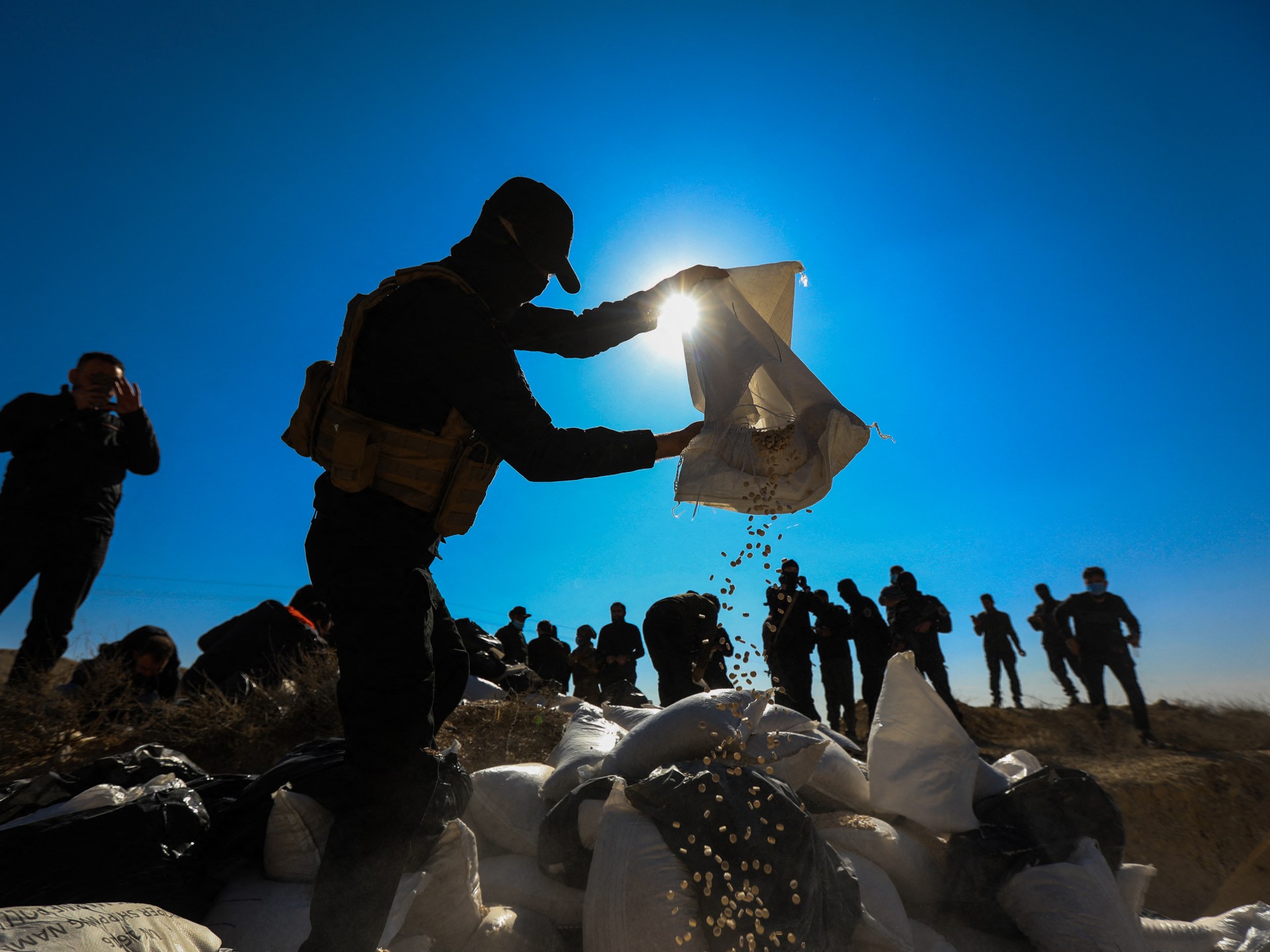
A member of Syria's security forces empties a sack of Captagon into a ditch to burn it in a field on the outskirts of Damascus (Bakr Alkasem/AFP)
Syria’s government has significantly disrupted Assad’s once dominant Captagon trade, according to a recent report by The Economist, which says President Ahmad al-Sharaa has made dismantling the narcotics industry a central part of efforts to restore international confidence and secure support for Syria’s reconstruction.
The report describes the Captagon trade as one of the defining features of the former regime under Bashar Assad, which transformed Syria into what many analysts characterized as a narco-state. Captagon, an amphetamine also known as fenethylline, became one of Assad’s largest exports despite being banned internationally in 1986 because of its addictive properties.
The UN estimates that as much as 80% of Captagon seized globally between 2019 and 2025 originated in Syria. The publication also reported that a pill costing only a few cents to manufacture could sell for as much as $25 in Saudi Arabia, with the global trade valued at up to $10 billion.
Transitional Government Intensifies Enforcement
As part of continued efforts to gain international legitimacy, the Sharaa administration launched an extensive campaign against drug production and trafficking. The Economist reported government forces seized more than 500 million Captagon pills and dismantled 16 industrial-scale laboratories during the first year of the transitional administration. With recent reports showing the trend has continued nearly two years later.
The publication noted Interior Minister Anas Khattab announced in June last year that Captagon production had ended in Syria. However, authorities have continued to seize narcotics, confiscating over 80 million additional pills over the past year. According to the report, some of those seizures came from stockpiles left behind by the former government, while others originated from newly established production sites.
The continued operations reflect the government’s effort to dismantle the infrastructure built under the previous administration while preventing traffickers from reestablishing manufacturing networks elsewhere in the country.
Suwayda Emerges as New Production Hub
While production has declined in areas under government control, The
Economist reported new laboratories have emerged in Suwayda province,
where Israeli-backed
Druze militias maintain control outside the authority of
Damascus. The report cited local outlet Suwayda 24, which estimated
that between 12 and 15 Captagon laboratories currently operate in the
province.
The report claims, remnants
of the former regime’s Fourth
Armored Division, once commanded by Bashar Assad’s brother and
widely accused of overseeing the state’s drug production network,
relocated to Suwayda after the collapse of the previous government
and resumed manufacturing there.
Much of the Captagon produced in the province is reportedly smuggled across the Syrian-Jordanian border before reaching Gulf markets. The report said interceptions along the border have nearly quadrupled since Druze-led forces assumed control of Suwayda in July last year.
Regional Cooperation Expands
The report highlighted growing cooperation between Damascus and neighboring Jordan to counter the evolving smuggling networks. In January, the two countries established a joint security committee focused on combating drug and arms trafficking while reinforcing security along their more than 360-kilometer shared border.
Jordan has also conducted repeated airstrikes against suspected production facilities in Suwayda, including a fifth round of strikes in May. Officials cited by the publication said those operations were coordinated with Syrian authorities. Smugglers have reportedly adapted by using GPS-guided balloons to transport narcotics across the border, prompting Jordanian forces to develop new interception methods.
Trafficking Networks Shift Beyond Syria
Although the Sharaa administration has substantially reduced
large-scale production inside government-controlled territory, The
Economist concluded that the regional drug trade has become
increasingly decentralized. The report said Hezbollah has renewed
Captagon production in Lebanon, while authorities have uncovered
manufacturing facilities in countries including Egypt, Kuwait, Sudan
and India.
Analyst Charles Lister told the publication
one-quarter of all Captagon seized by Syrian authorities during the
past six months originated in Lebanon. The Economist posits the
disruption of Syria’s once centralized drug industry has reduced
production within much of the country while also dispersing
trafficking networks across the region.